All posts by

Look Back in Anger: the miners’s strike in Nottinghamshire – 30 years on by Harry Paterson (Five Leaves, £9.99)
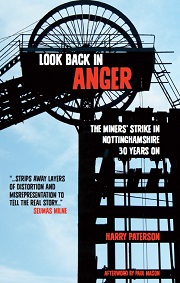
Paterson-Harry-LookBackInAngerOn 5th March 1984, following an Area ballot, Cortonwood pit in South Yorkshire came out on strike against the government’s proposed schedule of colliery closures. A domino effect followed, with the Yorkshire, South Wales and Scotland coalfields voting locally to strike. The much-repeated assertion that NUM President Arthur Scargill called for a national strike for reasons of political hubris is the first of many fallacies that Harry Paterson’s timely and unflinchingly powerful book explodes. Likewise the incessant right-wing carping, which continues to this day, that Scargill refused a national ballot; actually, a democratic vote at Conference went against it. The fact that the majority of miners in the UK were already out on strike at this point kind of speaks for itself.

Thirty years down the line, the miners’ strike remains a raw and emotional subject. Particularly in the Midlands. Every Nottinghamshire pit, most of them by a significant majority, voted to keep working. (Leicestershire demonstrated an equally pro-management stance; read David Bell’s The Dirty Thirty: Heroes of the Miners’ Strike, also published by Five Leaves, for a stirring account of the few men who stuck to their principles and supported their union.) A generation later, communities – families, even – remain divided. That is, where communities exist at all. The aftermath of Thatcher’s deliberate offensive against trade unionism is a country stripped of industry; a country of mass unemployment, of harsh class division, where a job for life is a thing of your father’s, or even your grandfather’s, generation.

My grandfather worked at Annesley. He was born in the last years of the 1800s. He was out in the Great Strike of 1926. He obviously died before the 1984/85 strike. I don’t want to conjecture about what he would have thought of the strike-breaking Notts majority. Even now, reading Paterson’s account, a sense of shame pervades. But to Paterson’s credit Look Back in Anger is more than just Scab: The Book. The opening chapters establish a history of mining and trade unionism in Britain, contrapuntally sketching in Nottinghamshire’s gravitation towards Spencerism and trying to define the prevalent social causes for such a move. Paterson progresses to a labyrinthine tour of the complex functionality of the NUM which – as the strike progresses and the union is increasingly besieged by Thatcherism, the media and the manipulated shift in public opinion – eventually sees the Nottinghamshire Area form the breakaway Union of Democratic Mineworkers. Paterson lays bare the political manoeuvring and dirty tricks that eased the UDM into being in a series of revelations as gripping as any thriller.

It would be disingenuous to suggest that Paterson is anything but on the striking miners’ side, but the steady accretion of new evidence, accounts and documents pertaining to the strike – culminating in papers released earlier this year under the Thirty Years’ Rule – leave no cause for doubt. Thatcher secretly marked 75 more pits for closure than were publicly mooted. At the time, Scargill called her plans “the thin end of the wedge”: history vindicates him.

Look Back in Anger (the title borrowed from John Osborne) is aptly named. To read it is to get mad. Mad at what happened back then. Mad at the fact that it’s still happening now. But the book is also studded with moments which illustrate all that is good and decent in working class men and women. One particular anecdote sums up the principles of solidarity and community that the striking miners were fighting for. A Newstead miner who’d spent his entire adult life at the coalface was on the cusp of reaping well-deserved redundancy benefits. Conflicted by management threats vis-à-vis loss of benefits vs kinship with his striking workmates, the strikers backed him wholeheartedly in returning to work; he saw out his stint, and contributed all his pay pay packets to the strike fund.

Neil Fulwood 


The Good Wife, by Elizabeth Buchan (Penguin, £15.99)

goodwife‘Never judge a book by its cover’ may be old advice, but it’s also a tempting piece of self-deception when you’re browsing the books section of a charity shop, feeling in need of an easy read.

The twee cover of The Good Wife shouts Chick-lit for Forty-somethings, with a little line of squeaky-clean washing suspended between two arty trees, beneath which a cat is dozing on the remaining washing in a basket. So, being somewhat over forty and not having read Elizabeth Buchan before, I bought it.

It soon becomes apparent that Fanny (short for Francesca in this case), the Good Wife of the title, does indeed consider herself to be a good wife to her husband, Will. But Will is about to stand for Parliament, and politicians’ wives are expected to take on the duties of that role. Fanny dislikes the prospect of endless coffee mornings and listening to Will’s heart-searching about his ambitions and his Party’s policies, and so the stage is set for her to walk out and take over her father’s wine business – a world which she has loved all her life.

But fortunately for my expectations, it’s not as simple as that. Descriptions of the minutiae of life in politics rang true and were fascinating in the first half of the book. Fanny has the additional problem of her alcoholic sister-in-law coming to live with them, but although this should provide extra incentive for her to go, her loyalty to Will keeps her there. Unfortunately, as the book passes the half-way mark and the inevitable crises encroach on the marriage, Fanny’s indecision gets a bit tedious. Her interest in the wine business (initiating too much detail about wines) almost resolves the situation, but somehow I didn’t find the ending convincing.

 Viv Apple

Viv Apple is a member of Nottingham Poetry Society and Nottingham Writers’ Club

Anarchists Against the Wall, edited by Uri Gordon and Ohal Grietzer (AK Press, £9)

anarchistswallSome years ago, a friend who lived in Belfast at the height of the war n Ireland said that she would see news coverage of the riots and shootings on the television and have to pinch herself to remember that she lived in the same city. She lived peacefully in an area quite untroubled by the war. I was reminded of this reading Anarchists Against the Wall as one contributor referred to those Israelis who feel no need to think about the occupation while sitting in a coffee shop or eating hummus in Jaffa. The one difference is that the man and woman in the Jaffa cafe have almost certainly been in the Israeli Defence Forces, or have children who have been, or children who will be. Yet the number of Israelis prepared to take action over “the situation” – hamatsáv – is few, especially at the cutting edge of protest against “the wall”. For many, emigration is a way out, with perhaps a million Israelis living abroad.

For a small number of Israelis, a life of permanent protest is the only option, Anarchists Against the Wall (AATW) being one of the most active organisations. In this short book AATW members outline their history and actions. The book is split between reprinting some AATW leaflets and a longer, and more interesting, section of personal accounts by activists. AATW began, formally, in 2003. The group rejects lobbying, electoral efforts and “interfaith” dialogue in favour of direct action and civil disobedience having “let go the coat-tails of the Zionist left” to work with the “popular committees” of Palestinians on the West Bank, especially at Bil’in and Ni’lin, on the weekly demonstrations against the wall. While twenty Palestinians have been killed in these types of demonstrations, AATW members have had no fatalities but share in being teargassed and being shot at by rubber bullets, and occasional live ammunition. They accept that they cannot be equal partners in resisting the occupation – Israelis can go home or drop out of activity at any time – but their solidarity actions give them “an opportunity to cross the barriers of national allegiance.”

The book is primarily about the group’s day to day activities, though demonstrations against the war in Gaza are also mentioned, with some reference to individual involvement in campaigns against gentrification within Israel, within the social movements and actions in solidarity with refugees. To the Israeli right AATW activists are traitors, more so to those who (shockingly) describe the 1967 Green Line as the “Auschwitz borders” to justify Israeli expansion. AATW has little time for groups like Peace Now, which have faded anyway after the failure of Oslo. One contributor remarks “So we give up on these people. Our statements [at general peace demonstrations] are not meant to communicate but to rage and keep us going.”

In exchange “Radical activists in Israel/Palestine run from one action to the next. It feels like everything is urgent.” Another writes “We hardly ever bother with promoting our various grand-scheme-of-things ideas. Once the occupation is behind us, we will have the luxury to discuss our diverse opinions.” A further contributor adds “Personally, I do not think I will see the end of the occupation in my lifetime — I am thirty years old.” Yet another, “’When the occupation ends. . . . ‘ How many times have we said this to ourselves, fantasizing over a future paradise, while becoming more and more cynical and disillusioned with each passing year. Today we know better. The occupation is not going to end; it is here to stay.”

Little wonder that the group is subject to burn out. One chapter is devoted to trauma, with some activists showing genuine symptoms of post-traumatic stress due their regular exposure to violence.

Some Jewish critics of Israel  will have found it difficult to speak of their views within the formal Jewish community, if involved in it, or within traditional Jewish families brought up on Zionism. For some Israelis, becoming a dissident means isolation from friends and family. “Like others, I have gradually lost contact with most of my friends from home. Some of us cannot deal with the confrontations and so we drift apart.” Whilst most Palestinians welcome Israeli Jews taking part in their struggle, others question this. “A local Palestinian farmer stopped me and bluntly asked what I was doing there. Why, for example, was I not in Tel Aviv talking to Israelis, or demonstrating outside the Knesset or prime minister’s house? I did not have a decent answer for him, but I did not go to another demonstration for three years, although I did not confront Israeli society either. I just left the country.”

I admire what AATW does, and would encourage people to read this book, yet I was left with a feeling of unease. So many of the contributors felt little hope for the future, and the weekly demonstrations clearly take their toll (exactly why the IDF comes down so hard on those taking part). Some of the writers remarked on how isolated they felt from all their fellow Israelis, how difficult it was, even, to take part in joint campaigns on other issues. Yet in the book there is only a passing reference to the International Solidarity Movement, which operates in similar territory, and no mention of, for example, Gush Shalom (the radical peace bloc), B’Tselem (the Israeli human rights organisation, active against the occupation), the soldiers’ movement Breaking the Silence, the Israeli Coalition Against House Demolitions or any other group which might not share AATW’s anarchist views but are on the same side. I wonder how much of the isolation is self-imposed. The book left me wanting to know more.

Ross Bradshaw

A version of this review will shortly appear in Jewish Socialist magazine


Chavs: the demonisation of the working class by Owen Jones (Verso, £9.99)

chavsA bookshop customer bought this the other day, together with a Bill Bryson book. Perhaps guessing that I was mentally raising an eyebrow he said that he knew that reading Chavs would put him in a bad mood so he was planning to read Bryson afterwards to make himself feel better. He had a point.

A year or two back Chavs was the must-read leftie book. It really took off – I bought my copy at the time from a WH Smith’s bookstall in Crewe railway station. I’ve only just got round to reading it, to my shame. In the meantime Owen Jones has become the Milky Bar Kid of the British left (a phrase coined by the Five Leaves’ writer Harry Paterson), the Tories have got worse, UKIP are on the rise, but fortunately Jones’ chapter on the BNP has become out of date. And I suspect that a lot of people who bought this book have not quite finished it yet.  Why not? Because it really is bloody depressing.

I read the book with a view to covering it here, and turned down so many pages from which to quote – Jones knows how to marshal his facts.  Here’s one I did not know – “over half of the top one hundred journalists were educated at a private school” – one of the reasons for their distaste at worst and lack of understanding at best for the working class, especially those from the north. I could have filled this short review with a fraction of Jones’s battery of facts which present a convincing case for the deliberate break up of working class organisations and ways of living – think the decline of trade unions, the deliberate rundown of industry and the great sell off of social housing – and the “chavification of working class people, the constant portrayal of them/us as being “‘non-aspirational’ layabouts, slobs, racists, boozers, thugs – you name it”. We can see this most in the current millionaire cabinet attack on those who are not in work or claim benefits.

Chavs is essential reading but I got more out of the forthcoming The People: the rise and fall of the working class 1910-2010 by Selina Todd (John Murray, £25, due April) as though the working class lost out in the end at least some of the century was “ours”. A review will follow at some stage. Owen Jones’ book could be summed up by one of his sentences: “Chav-hate is a way of justifying an equal society” which “justifies the preservation of the pecking order, based on the fiction that it is actually a fair reflection of people’s worth.” He is not wrong.

Ross Bradshaw

Reading Barry MacSweeney, edited by Paul Batchelor (Bloodaxe, £12)

readingbarrymacsweeney

The essays Paul Batchelor has assembled in this volume hide behind a prosaic and somewhat misleading title. This is not so much a reader’s guide as a series of specific responses to MacSweeney’s life and work, some defiantly cerebral, some forged in personal memory and anecdote.

MacSweeney was post-war British poetry’s lone wolf: a journalist rather than an academic, an endlessly self-reinventing experimentalist, a man who rejected trends and movements. It’s no coincidence that his earliest important poems was called ‘Brother Wolf’, and his Selected Poems was issued as Wolf Tongue. MacSweeney had bad experiences with mainstream publishers; much of his output was via small presses. Even the release Wolf Tongue and its preceding volume The Book of Demons under the Bloodaxe imprint was bittersweet: they’d previously rejected his 1985 sequence Ranter.

Perhaps it’s appropriate, then, that the ten essays in Reading Barry MacSweeney add up to a fragmented, troublesome and argumentative book. Harriet Tarlo’s placing of MacSweeney in an “old-new” poetic tradition has a lot of thought behind it but reads like a first year university student thesis, overburdened with assertions of “I shall demonstrate” variety. John Wilkinson’s aggressively academic analysis of MacSweeney’s political poems is made from an ivory tower, demonstrating abject naivety regarding the British political landscape of the 1980s. His essay is full of statements like “the power of Barry MacSweeney’s best poems lies in their creative and integrative summons to the reader, surprised into poetic activity which has not been advertised according to post-authorial dogma”. And that’s one of the easier sentences to parse!

On the plus side, W.N. Herbert offers a highly readable overview of The Book of Demons; Matthew Jarvis evocatively maps the Northern landscape that provides a rugged backdrop to the best of MacSweeney’s work; editor Paul Batchelor relies on close reading and textual reference, hewing as close to the poetry as possible; Andrew Duncan brings insight and empathy to the story behind the unfinished Black Torch sequence; and Peter Riley and William Walton Rowe offer coolly objective analyses of MacSweeney’s heroes and nemeses respectively.

 The two best pieces are by the contributors who knew him. Terry Kelly considers MacSweeney’s musical influences in a warm, poignant and beautifully understated mini-memoir. S.J. Litherland, MacSweeney’s partner in the last decade of his life, lovingly reconciles the different aspects of a troubled and brilliant individual, citing instances of MacSweeney the journalist using his position to champion the underdog that will make you want to stand up and cheer. These two essays alone make Reading Barry MacSweeney a worthwhile purchase. They bring you MacSweeney the human being in all his conflicted and vulnerable glory.

 Neil Fulwood


In the Dark by Deborah Moggach (Vintage, £8.99)

inthedarkThis year, 2014, will be notable for its commemorations of the Great War, but Deborah Moggach’s novel In the Dark (first published in 2008) was not written with this in mind, though it could have been. Set in 1916, it has no scenes in the trenches but is about the war from a refreshingly different viewpoint.

Young Eithne Clay runs a boarding house in London, assisted by her fourteen-year-old son, Ralph, and their ‘help’, Winnie. By page four Eithne is a war widow, and the story of how the family and its assortment of lodgers cope with life in the house is seen through the eyes of the adolescent Ralph – but not in a mawkish way. As Eithne struggles financially to keep things together for her son and the lodgers, she accepts the attentions of the local butcher, Mr Turk, who woos her with extra rations of meat and promises of a better life. The old house is transformed when Mr Turk moves in and installs electricity, gradually throwing light, literally and metaphorically, on the lives of its occupants. Ralph learns what it means to grow up through his interactions with Winnie, with blind Alwyne – invalided out of the army – with Boyce whom he regards as friend and mentor, and with the other lodgers. Each character is so brilliantly drawn that we can identify with their situation in 1916 as clearly as if it were happening now.

For some reason, Deborah Moggach’s two most popular novels, The Best Exotic Marigold Hotel and Tulip Fever, seem to overshadow her others. Much as I enjoyed Tulip Fever, the emotional involvement I felt with In the Dark made this book far more memorable. It would make a wonderful film to add to the already long list of reminders of WWI.

Viv Apple

Viv Apple is a member of Nottingham Writers Club

Fighting Fit: a memoir by Chanie Rosenberg (Redwords, £6.00)

fightingfitLast year, at the Jewish Socialists’ Group annual seder/Passover meal, people were reading stories and poems of liberation. Someone read a poem by Isaac Rosenberg, one of the greatest of  poets of WWI (in which he was killed). MCing the event was the Five Leaves writer David Rosenberg who remarked that he was unrelated to the poet… but one of the others present was Chanie Rosenberg, a first cousin of Isaac’s. Chanie, who was born in 1922 obviously never met her cousin, but talked about his short life and work with the background of family knowledge. It felt like a magical moment, with the long dead Isaac Rosenberg almost, almost within touching distance.

Unfortunately Chanie does not include mention of her connection to Isaac Rosenberg in this short memoir. Indeed, the memoir barely touches the surface of her interesting life. I wish she had written more. Some of the text is bitty, but she shows flashes of inspiration, for example when she describes her courtship with Ygail Gluckstein/Tony Cliff in Palestine saying “Cliff was attracted by my South African passport. [He had been desperate to find ways of leaving Palestine.] Bolstered by this and possibly some other useful characteristics, we started living together.”

The memoir is particularly strong on her early years in South Africa, where Jews were considered white but subject to racism by the English and Afrikaaner majority among whites. She describes knowing one Black family which had members who could pass as white, who no longer talked to one another to avoid risking the “white” members being exposed. Chanie rejected South African racism and, later, Jewish nationalism in the form of Zionism. With Cliff she was one of the founder members of the group they set up after leaving Palestine, which became the Socialist Workers Party. The SWP was once the biggest group on the UK left, now in serious decline following various internal bust-ups over sexual harassment by a leading member. Chanie remains loyal to her Party. Her own political involvement included successful activity in the National Union of Teachers, for which she was blacklisted for some time. Unfortunately the memoir skates over most of the issues the SWP has been involved with over the years. It would have been nice to have known what she really thought.

The memoir includes a quite unrelated, but excellent, illustrated essay on the Russian painter Kazimir Malevich, indicating the Chanie Rosenberg could have been a significant writer had she given more time to it.

Ross Bradshaw


The Richard Burton Diaries, edited by Chris Williams (Yale University Press, £12.99)

BurtondiariesNearly thirty years after his death, The Richard Burton Diaries gives us a portrait of the actor so illuminating and no-holds-barred honest that it’s a tragedy he never marshalled his reminiscences into an autobiography. The book is edited by Chris Williams, whose love of footnotes is as all-consuming as Burton’s torrid passion for Elizabeth Taylor.

Clocking in at nearly 700 pages, the diaries are ordered into six main sections: 1939-1940, in which a series of regular but short entries give a snapshot of his childhood and a burgeoning love of literature; 1960, which is little more than an appointments diary; 1965-1972, which spans almost 500 pages; 1975, documenting his brief remarriage to Taylor and an unhealthy amount of drinking; 1980, centring mostly on his theatrical tour with Camelot; and 1983, which ends as he’s about to take to the stage again in Noel Coward’s Private Lives, an ill-fated production that co-starred Taylor.

As one would imagine, the Burton-Taylor years occupy centre stage. Cineastes will regret the lack behind-the-scenes on some of Burton’s most celebrated performance – there’s barely a word on The Spy Who Came in From the Cold, Becket or Night of the Iguana – but what there is, in plenitude, is an account of Burton’s life – the travel, the glamour, the fabulous restaurants, the glitzy hotels, the premieres and hobnobbing. He almost casually records his acquisition of extravagantly priced jewellery, a yacht and a private jet. “I did something beyond outrage,” he says of dropping $960,000 for the latter – this in 1967, the equivalent of $6.5million today!

In the wrong hands, this could have been the stuff of gloating. But everything Burton writes is tempered with his background, the poverty of his childhood, the admission – made repeatedly – that he’s been lucky. Moreover, fame and materialism didn’t lull him into intellectual moribundity. Throughout Burton demonstrates an inquiring mind, a thirst for knowledge, a keen engagement with the written word and a fascination with linguism.

I haven’t enjoyed an actor in his own words this much since Ever, Dirk, John Coldstream’s volume of Dirk Bogarde’s waspish and unmediated correspondence. Bogarde, of course, enjoyed a second career as a memoirist, novelist and reviewer in the last two decades or so of his life. It’s a damn shame Burton didn’t get to tread a similar path.

Neil Fulwood

Ghost Writer by Andy Croft (Five Leaves, £7.99)

The narrative of Andy Croft’s verse-novel is basically Hamlet relocated from Elsinore to a dingy flat and playing out against a backdrop of left-wing politics and the Spanish civil war instead of the wasp’s nest of court intrigue. Oh, and written in Pushkin sonnets as opposed to the iambic pentameter. But apart from that, we’re definitely in Hamlet territory as reluctant hero Tod Prince (geddit?) struggles against the nefarious machinations of Claud King (geddit? part two), tries to romance the headstrong Fee (geddit? part three) and deals with unwanted ghostly visitations.

Tod’s a down-on-his-luck writer who hopes his long-gestating biography of 1930s poet Rex Dedman – who, as his name would suggest, is now deceased – will be a critical and financial success. Claud, publisher and rival for the affections of Rex’s wife Trudi, is working on his own memoir and tries to coerce Tod into a version of events designed to bolster his revisionist take on Rex’s life and smooth over a particularly gnarly secret that both men were party to back when they were fighting to protect Spain from Franco’s fascism.

Different stories emerge as first Rex then Trudi visit Tod from beyond the grave, with each character’s version of events taking on a different colouration (think Rashomon conflated with Land and Freedom) but amidst the deceptions, betrayals and bed-hopping, who’s telling the truth and how is Tod meant to arrive at a definitive narrative?

Ghost Writer is an absolute tour de force. By turns a mystery, a love story, a ghost story, a war-time thriller, a political treatise and a satire on the literati, Croft covers more ground in 140 sonnets than most novelists could manage in a 600-page door-stopper. The fact that he keeps the whole thing ticking along so wittily and so readably is the clincher.

Neil Fulwood
See below for Neil Fulwood’s review of Andy Croft’s later book 1948

Stoner by John Williams (Vintage, £8.99)

By now, the story of this novel is as well known as the novel itself (see http://www.theguardian.com/books/2013/dec/13/stoner-john-williams-julian-barnes) and Private Eye has commented about the way the book has been promoted by Waterstones and a bunch of mates. So maybe it is not such a word of mouth sensation as first thought… But it was a non-Waterstones bookseller who gave me a copy months ago, saying that I’d like this, and not to worry about the title being Stoner, it was unrelated to my hippie past.
So, this is a novel about an obscure American academic’s career, first published in the 1960s to small attention, which hung round Vintage for ten years not selling well, went into the limbo that is Print on Demand, then came back to life and has now sold squillions, and is all over the front table at Waterstones (and Five Leaves). But is it any good?
I think it is, but with qualifications. The shy and awkward William Stoner is from a hardcrabble family, who goes to study agriculture, falls in love with literature and spends his whole career at the same college as a student and a teacher of literature. Along the way he finds a wife who makes his life a misery, is made miserable by a secret relationship with one of his students (more on this in a bit) and is bullied at work by a disabled supervisor because he did not give a pass to a disabled student who his supervisor favoured. And the daughter he loved turns to drink. Sounds pretty awful then. On this basis the book sounds like a cross between JM Coetzee’s Disgrace and Philip Roth’s The Human Stain with a bit of David Mamet’s Oleanna thrown in. But it is a slow build and while Stoner is persecuted it is clear that his relationship with his grad student is loving and only fell apart because of the mores of the era (but still.. the book is being boosted by a lot of late middle aged men connected with academia…). Stoner fights back against the bullying, but subtly, and his boss does not speak to him for twenty years and even then is still trying to get him out of the college.
Hmm. I don’t think I’m convincing anyone in any direction here. Maybe just read it. Let me know what you think.

Ross Bradshaw