All posts by

Light at the End of the Tenner by Andrew ‘Mulletproof’ Graves (Burning Eye, £10)

Light at the End of the TennerAlready a local legend on the performance scene, Mulletproof’s first full-length collection stakes an immediate claim to cool based on the cover alone. A striking image by Mark Dickson is capped with this quote from Jim Bob (of Carter the Unstoppable Sex Machine fame): “Like finding a great lost Roger McGough collection in a box in the loft.”

It’s a good call: the poems on offer here are as grounded in reality and conversational in their aesthetic as anything by McGough. But the ghost of Adrian Henri suggests itself in ‘Wings’, ‘The Love Tree’ and ‘It’s No Longer Tomorrow, Yet…’ – the latter the most nakedly experimental piece in the collection. In fact, Light at the End of the Tenner is thronged with ghosts: Soviet cosmonauts, rock ‘n’ heroes, suicidal comedians, B-movie casualties, and Jimmy from Quadrophenia riding Ace Face’s Lambretta over the cliffs and into eternity.

 Mulletproof’s subjects are certainly eclectic. From a geriatric Elvis swapping Graceland for a trailer park to deer armed with Kalashnikovs squaring up to their erstwhile hunters (“no more roof rack mortuaries / or tailgate processions // just the sun shot green canopy / and the assurance of a fair fight”), the poems bristle with attitude as they blaze their way through half a century of pop culture, span the globe and (quite literally) shoot for the moon.

But Mulletproof’s hometown is always the anchor. ‘Radford Road’ is an impressionist portrait of Nottingham in all its on-the-streets glory, while ‘Rammel Nitrate: Nottinghamshire Kisses and Laced History Lessons’ whizzes slap-bang through the county’s history, picking out a through-line of what made it the place it is today, while ‘The Loneliness of the Long-Distance Rumour’ sees Alan Sillitoe’s racing-throwing anti-hero eternally on the run.

Clocking in at a chunky 116 pages (steroid poetry in a culture where most collections barely tap out at half that length), Light at the End of the Tenner captures on the page what anyone who’s seen Mulletproof live cherishes about the man: flair, fury and flippancy in roughly equal measures.

 Neil Fulwood


North Korea: state of paranoia by Paul French (Zed, £12.99)

NorthKoreaIf I was offered a choice of two weeks in a caravan in Mablethorpe or an all expenses paid fortnight in Pyongyang it would be a hard choice, but for a tiny group of British communists Mablethorpe would face instant rejection. Surprisingly, even now, the intellectual descendants of those who checked out the weather report on Radio Moscow, pored over tractor production statistics in Ukraine, took the side of China in the Sino-Soviet split, struggled with the pronunciation of Enver Hoxha when it was time to move on to Albania believe that North Korea, run by a hereditary dictatorship, is a socialist paradise. Even after Kim Jong-un offed his uncle that’s OK by them. The number of such people – followers of the “Juche” theorie of Jong-un’s granddad – is tiny, but a lesson to us all in showing why we should avoid hitching our wagon to some foreign state about which, really, we know nothing.

Anyone reading Paul French’s book on North Korea must surely despair that anything good can come out of this. He analyses the history of the regime, its changing fortunes (prior to mass starvation, it was actually doing quite nicely), its armaments, economics, the possibilities of reform and its relationship with the outside world. The three countries that matter to it are, of course, South Korea, China and America. The big issue is nuclear. Feeling constantly under threat, and in need of a bargaining chip, North Korea has armed itself to the teeth. Most countries do, but perhaps the lesson of Iraq is that such rogue states feel that they do need weapons of mass destruction to protect themselves. Or is the nuclear option simply a bargaining chip to ensure that the hateful West continues to bail out the country by giving aid?

Paul French tells us all that we need to know about North Korea, but one line stands out: according to the Seoul government North Korea (or more correctly the Democratic Republic of People’s Korea) need only reduce their arms spend by 5% to resolve the country’s food crisis.

Ross Bradshaw

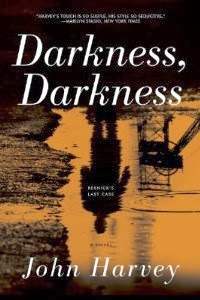
Darkness, Darkness by John Harvey (Heinemann, £18.99)

darknessdarknessIt’s not often I can say that I changed the course of literary history, but after I read a proof copy of John Harvey’s book I emailed him to say he had got a small but important detail of the aftermath of the 1984/85 Miners’ Strike in Nottinghamshire wrong and that he was not as conversant with the history of the  local Robin Hood Railway Line as he could have been. John received the comments on the last day it was possible to make changes, and, rather than responding “nobody likes a smart-arse, especially one who knows about trains”, he was able to get the publisher to make the changes. There we have it then, another novel saved from sin… or at least two small sentences amended that perhaps nobody else would have noticed, but still.

The paragraph above makes it clear that this novel is set in Notts, thirty years ago. It is, and in Notts nowadays too, thirty years after the strike, with Harvey’s Resnick called in to help a cold case when a body turns up, almost certainly someone who disappeared during the strike… a woman who campaigned against the pit closures, her husband being one of the Nottinghamshire majority who did not strike. Resnick had been there at the time of course, running agents in the coalfields who reported to him, and he reported up the line in turn. Resnick was not proud of what he had done, justifying it as helping to stop the prospect of civil war in the coalfields, coalfields in which he had friends on both sides of the picket line. And maybe he had nothing to be ashamed of, and maybe he did.

The first Resnick book appeared in 1989, Lonely Hearts, and this is the twelfth – and last – novel. Five Leaves has a walk on part in the Resnick saga as we published a novella and a limited edition of Resnick short stories, so I am  not unbiased here. I like the series. I’m sorry that this will be the last, but that is John’s choice and he wanted to leave with as good a book as possible. And, mostly, it is. My reserve is twofold – the cold case device used to get Resnick back as a working policeman and his new working partner, the Kenyan Catherine Njoroge. The former I’ll accept, as how else could Resnick return at his age? The latter, in my opinion, does not work as well as some of his previous characters. But these are small points, and Harvey does leave Resnick as he should, working on a major Nottinghamshire story – perhaps the strike was the Nottinghamshire story of the last generation – and with the audience left wanting more. It is also a good fictional coda to the other material that has been coming out on Nottinghamshire in the strike year. And I think he gets the atmosphere of the time and place right.

Charlie Resnick will survive in people’s memory as a wonderful character, naturally flawed. A bit rumpled, a jazz fan, an outsider, a cat lover, someone never quite at ease with his role as a policeman but a copper who tried to use his role for good and as someone able to see the good in others. He will go out in a blaze of publicity – the author has thirty events in his diary already. I’d encourage you to attend at least one, locally at Waterstones, at Lowdham Book Festival, at Worksop and Newark Libraries and at the Bookshop. Though the Bookshop event will focus on John Harvey’s poetry for here too there will be a final volume, published, as this book is, on May 22. See the shop’s events list for details.

Ross Bradshaw

A Brief History of Whistling by John Lucas and Allan Chatburn (Five Leaves, £9.99)

Brief History od Whistling

Five Leaves boasts an eclectic list: fiction, non-fiction, politics, social history, essays, verse novels … you name it. What’s that you say? A book on the history of whistling? Yup, Five Leaves have published it.

John Lucas and Allan Chatburn’s good-natured overview begins with an investigation into the mechanics of whistling and determines that Lauren Bacall’s oft-quoted line from To Have and Have Not – “you know how to whistle, don’t you … just put your lips together and blow” – is something of an understatement. As a sassy double entrende, it’s hard to beat, but Lucas and Chatburn uncover more than enough evidence to prove that whistling is, in fact, an art form, one requiring practice, discipline and dexterity.

But like all art forms, whistling can have its subversive practitioners. The authors present instances of whistling as a form of protest – from the iconic ‘Colonel Bogey’ scene in David Lean’s Bridge on the River Kwai to the Cretan shepherds who, in the real-life theatre of conflict, whistled in code to alert resistance fighters to the proximity of Nazi patrols – or as a similar tool of communication between criminal gangs. A sign at the Burlington Arcade in Piccadilly permits the Beadles (i.e. the security staff) to eject anyone behaving in a disreputable manner; historically, this included whistlers: accomplices reconnoitring the arcade would whistle to tip-off thieves to easy targets.

Bans on whistling extend to the working environment (miners at the coalface and theatre hands behind the scenes – in both cases, health and safety considerations mandate the ban), though elsewhere whistling is culturally intertwined with professions: the shepherd who instructs his dog with specific variances of tone and pitch; ploughmen signalling a turn at the end of the field; tinkers and butcher-boys whistling to announce their presence.

Whistling in literature offers plentiful material, from the bustling descriptions of Dickens, to Hardy’s critique of a patriarchal society and the prejudices by which a woman’s reputation can suffer in Tess of the d’Urbervilles. Edward Thomas’s poem ‘The Penny Whistle’, a lament for a changing England written in the early months of the Great War, is quoted in full and sensitively analysed. John Hartley Williams’s ‘Music While You Walk’ is given equal consideration; likewise Paul McLoughlin’s beautifully evocative ‘Whistling’, which closes the book.

A Brief History of Whistling is an eccentric but eminently likeable work. At a shade under 170 pages, it doesn’t outstay its welcome, but instead deals out a wealth of little-known facts and anecdotes. The prose is elegant but wittily crafted. At the risk of a crass and obvious analogy, if this book were a person it would be a 1920s dandy, whistling jauntily and twirling its cane as it swaggers confidently onto your reading list.

Neil Fulwood


The People in the Photo by Helene Gestern, translated by Emily Boyce and Ros Schwartz (Gallic Fiction, £8.99)

People in the PhotoA few years ago my elderly mother sent me a mysterious photograph of her much younger self in the arms of a black man. She said it was important that she passed on the photograph but did not want to tell me the background – she just wanted me to have it. The man was black in that he was burnt black by the sun rather than being African or Caribbean. What was this story? Wouldn’t anyone want to know? I was reminded of Stephen Poliakoff’s Shooting the Past, where a film library was under threat of closure and the staff need to save these images of the past.  Our family lost most of their photographs in a house move which perhaps makes me more interested in what old pictures can reveal, or conceal.

The People of the Photo, then, was a must read. Helene, who did not know her mother, finds an old photograph of her with two unknown men. What was the story, who were they? She advertises and is contacted by Stephane who knows part of the background. Both the characters are single, in their late thirties, and it becomes obvious their families were connected, but how? As they live in different countries Helene and Stephan ewrite and email as each finds just a little bit more background, gets closer to the truth. There was a hushed-up affair, and a tragedy, but what really happened? Why are things so secret? And… are they siblings? Difficult, as they are clearly falling in love. The chapters of the book are short, exploratory letters and emails that gradually open up – the two gradually open up to each other as they open up the past.

The first half of the book worked very well for me, the letters and emails both felt like they were from women used to being on their own, being able to open up because they were writing. But wait! Half way through I realised that Stephane was a man. My ignorance of French names made a fool of me. But that was when I began to have doubts about the book – possibly the author could not write letters as a man would write which led to my guessing it was between two women. It was when they admitted their love that the book began to fade for me slightly. But I was pleased to stay with the book and to finally understand what created the dysfunctional families who brought them both up in ignorance of their past.

The translation is superb and I loved those parts of the book set in the one part of Paris I know reasonably well.

Ross Bradshaw

LOLCat Bible by Martin Grondin (Ulysses, £7.99)

LOLCat_BibleI was harmlessly staffing the bookshop front desk when this dude (he would like that description) comes in and asks if we stocked the “Lowkat Bible”. “The what?” “The Lukat Bible.” “The what?” I’m thinking it was some religious grouping I’d not heard of – and was not wrong. But before we say any more my colleague Ben and the dude start talking to one another in something that sounded like Jamaican patois but might have been Etruscan. Neither Ben or the dude are Jamaican, though they might be Etruscan. Just as I thought it was time to find some interesting filing the duo reverted to English and explained that this was a book and it was something to do with the internet and cats. Oh really; the internet and cats? That’s unusual.

The next day other members of staff are speaking Etruscan too, and laughing over the dude’s book, or rather one of SEVERAL copies that appeared to be stock. And here it is in my hands. An example: So Ananias wented to howse. He foundz Saul and dud wut Ceiling Cat say. He places paws on Saul. Ananais sed, “Hai Saul, Ceiling Cat, who pwnded your eyez with crazie lite, sented me to yu so you cans be filld wit teh Hover Cat. kk? You can has site bak.” Then weerd scaly thingz fell frum Saul’s eyez. Saul seez again, ftw!!!

I am a fan of Song of Solomon, or at least was until I read: Ur like teh horse. Wait, no! Liek… liek teh wunz on teh cheryits of Pharo. So here we have it, LOLCat Bible is like the King James Bible, but without the beautiful language and shorter. And with pictures of cats in it. 

Ross Bradshaw

Going to the pictures: a short history of cinema in Nottingham by Michael Payne (Nottingham Civic Society, £4.99)

GoingtothePicturesJust round the corner from the Bookshop on Long Row was once the Long Row Picture House, opened in 1912. That particular cinema was one of the big two in Nottingham, with 600 seats, some of whose patrons paid a bit more to sit in the balcony. There was a cafe and a continuous programme from 1.00pm-10.30pm. Sadly the cinema did not make it into the era of the “talkies” and closed in 1930. The once beautiful building is now marred by a cheap and nasty sign saying Ladbrokes, but look up, the rest of the frontage is still beautiful.  The other of the big two was the Elite on Parliament Street, which could hold 1,500. This cinema had a special floor in the foyer to minimise noise, an enormous electric organ, a full-scale restaurant, a gentlemen’s smoking room and a ladies room.

But you could start this review with many “just round the corner” lines as Nottingham – like other big towns – was packed with cinemas in the city centre and in the suburbs. Packed, I tell you.  And they are all here in this book. With lovely photos, the stories of the cinemas, memorabilia. And on the cover is a lovely photograph of Broadway – an interesting choice given the range of historic cinemas inside. Broadway itself has some history too. I can remember its predecessor, the  old Coop Cinema, a part-time enterprise where they did not so much advertise changes in the programme as changes in the audience as everyone there seemed to be regulars who all knew each other.  Cinemas are not just buildings. This short, very attractive book will be a local  best-seller. Well done, Michael.

Ross Bradshaw

Sworn Virgin, by Elvira Dones, translated by Clarissa Botsford (And Other Stories, £10)

swornvirginYears ago, a book group in Mansfield introduced me to the work of the Albanian writer Ismail Kadare, still the best known Albanian writer, who writes a foreword to this novel by what must be one of the few female Albanian writers published in English. Dones covers some of the same ground as Kadare, the rigid behaviour codes in the north of the country – the Kanun. In this book the code means that the female Hana Dona takes over her late uncle’s farm but she has to dress as a man, drink and smoke like a man, act in every way as a man – but must remain a virgin, a sworn virgin, to uphold the honour of the family as she is the only person left to run the place. To do this she gives up her sophisicated life in Tirana to become Mark. Her becoming a man is celebrated in her village of 208 souls, and she is honoured for so doing, no longer treated as second class, the usual female role.

Fourteen years later – after the downfall of Enver Hoxha (in a nice touch her uncle’s goat was secretly called Enver) she joins her cousin in America, one of the million Albanians who left the country in search of a better life and, after some hesitation, Hana gives up her life as a man. The book switches between the two eras. In due course she settles, becomes independent and grapples with the issue of sex.

Having had recent discussions with some people about our “binary” culture, this novel was timely. People like Hana/Mark did exist in Albania and a film is planned. The author interviewed many of these (wo)men including one who did migrate to America.

The book itself is strongest in its Albanian chapters. Life in America was not so believable, not least when Hana became a bookseller and took a prospective boyfriend out for a posh meal. Booksellers taking someone out for a posh meal? No chance. But while Hana’s wrestling with sexuality is not an issue, she was always a woman in man’s clothes and adopted behaviour, her attempts to deal with sex itself did not ring true. The translation could have done with a polish at times, occasionally being a little cliched in its language. Nevertheless the novel is an interesting read. But you will have to wait – the book is not published until 4 May.

Ross Bradshaw

Grayson Perry by Jackie Klein (Thames and Hudson, £24.95)

Grayson-PerryThis book made me laugh out loud. It started with the Westfield Vase, which appears towards the end. Grayson Perry made the pot with a map of Westfield on it. He writes, ‘Westfield shopping centre had just opened in Shepherd’s Bush, a sort of Death Star of consumerism landed in West London … It’s an enormous sophisticated machine for selling stuff, none of which I would want to buy.’ He smashed the vase with a hammer, and then a ceramic restorer, Bouke de Vries, stuck it back together again using filler covered in gold leaf. ‘The gold lines represent a kind of alternative map; they are almost desire lines, but desire lines of destruction,’ Perry writes.

 Using gold leaf reflected the traditional mending with gold lacquer of ancient Chinese or Korean vases, which Perry had seen at the British Museum (a favourite place). ‘I love that history of honouring important ceramics,’ says Perry. ‘As an object lover, it’s great; this is veneration of the object at its most extreme. I wanted to combine that idea with something that really horrifies me.’

Such tension permeates this uplifting collection. Fragile vases might be smashed or broken at any time. A new generation is sucked towards the Shepherd’s Bush Death Star, but Perry characteristically goes in the opposite direction. There is real iconoclasm about his work,  which subverts the form (icons, quilts, as well as ceramics) with outspoken content, often personal (‘look mum, i’m a jet pilot’), often public (dolls at dungeness, september 11th, 2001). He does this with consummate skill; an artist with a manifest appreciation of his chosen media.

 Beautifully printed in Singapore, and reasonably priced for what it is, this stunning collection comes to life courtesy of the artist’s outspoken commentaries on his own extensive output.. Essex has another great artist to rank alongside John Constable.

Tony Simpson


The Road to Middlemarch by Rebecca Mead (Granta, £16.99)

MeadRoad

We all have gaps in our reading: it’s impossible not to, there’s just too much out there. Even narrowing it to the established classics, those works of literature that have been defined by longevity, makes for a formidable cross-section of eras, styles and nationalities. One of the big gaps in my own personal reading was George Eliot. I’d always meant to … never got round to … been put off by yet another entirely turgid BBC adaptation … The excuses were always there.

Then I was offered a review copy of Rebecca Mead’s The Road to Middlemarch, which I accepted enthusiastically, intrigued by the cover blurb’s promise of “literary biography, deep reading and personal memoir”. And if as a result I finally tackled a volume of Eliot, so much the better. After just ten pages of Mead’s book, I was in a quandary: I was wholly won over by Mead’s critically intuitive but winningly warm-hearted prose style and could have devoured the book in one sitting. But I was acutely conscious that it would yield so much more if I read Middlemarch first.

I ended up reading the two in tandem. Mead structures her account of Eliot’s keystone work, placing it in the context of her life and career, in parallel with the eight books of Middlemarch. I pendulum’d between Eliot and Mead over the course of three weeks, feeling like I’d come to know both writers as well as exhaustively touring every scrap of geography that was distilled into Eliot’s quintessentially provincial English town. Serialised during 1871-72 and set just prior to the Reform Act of 1832, Middlemarch is one of the most immersive and unflinching portrayals of the politics, prejudices and patriarchy that underpin English society. With the media sharpening its claws over the George Eliot Hospital while I was reading it, and a major subplot in Middlemarch detailing the financial shenanigans and administrative string-pulling behind the establishment of a new hospital, the old cliché never seemed truer: the more things change, the more they stay the same.

Middlemarch is primarily a study in defeated idealism: Dorothea Brooke’s is misplaced, Tertius Lydgate’s is poisoned by hubris. But there’s so much more to it, and Mead traces the book’s importance – one might even say centrality – to her life, teasing out the aspects that struck the most resonant chords at different stages in her own personal journey. The Road to Middlemarch is aptly titled: Mead’s peregrinations take us through her life, through Eliot’s, through English history and the English landscape, and through the drawing rooms, farmyards, offices and billiard halls of Middlemarch itself. It’s a perfect companion piece to a colossus of a novel, illuminating, intelligent and richly rewarding in its own right.

 Neil Fulwood