All posts by

The Sun Bathers by Roy Marshall (Shoestring, £9.00)

the sun bathers

Roy Marshall’s debut collection takes its title from the linocut by Leonard Beaumont that is reproduced on the cover. Marshall imagines the 1930s bathing beauties as sisters – “let’s call them Dora / and Emily. Both warm-drowsy, both eighteen, / born on the eve of a war they’re told / their fathers fought” – and captures them in a last summer of innocence before global conflict again explodes: “none of us can say / who’ll be a WAAF or WREN, working the land / or in a factory”. Marshall concludes the poem with a grimmer prediction for the carefree lads hovering near them on the beach, their minds on romance and not the immanence of war.

‘August 31st, 1961’ similarly places a perfectly captured moment in time (the birth of his sister) against the bigger picture of the history books. “In the hospital car-park in Surrey / our Dad is watching the moon rise, / already a target for Kennedy”. Here, Marshall’s style is sparse, the maximum communicated with an economy of language. A sense of precision, of words carefully and purposefully chosen, characterises The Sun Bathers. Which is not to suggest that Marshall is a minimalist: these are poems that have depth and weight; their author’s skill in structure and lineation ensures they have room to breathe on the page.

Subjects are diverse, and Marshall certainly knows his history (pace the sequence about da Vinci that forms the collection’s centrepiece), but he’s arguably at his best when memory and autobiography infuse his work. ‘The Bow Saw’ became an immediate favourite on first reading and I’ve gone back to it several times: a simple recollection of father and son collecting fallen branches from the local woods, its half dozen quatrains are a masterclass in tactile evocation, taut use of poetics and how to achieve poignancy without succumbing to nostalgia. “I learnt the languages of wood: / dense oak coughing fine dust, jamming / the blade in the cut, asking more from / an aching arm, a racing heart and lungs”.

 The Sun Bathers is accessible without sacrificing erudition, sensitive yet muscular when it needs to be. Marshall has a fine talent for elegance and clarity. His poetry exerts a very quiet, understated spell: it keeps drawing you back.

 Neil Fulwood


It Goes With the Territory: memoirs of a poet by Elaine Feinstein (Alma, £20)

it goes with the territoryElaine Feinstein is the author of sixteen collections of poetry, three collections of poetry in translation, fifteen novels, two short story collections and seven biographies but has chosen “memoirs of a poet” as the sub-title of this book rather than a “writer”, giving away immediately her main interest and leading us to the world in which she made an unlikely entry so many decades ago. Against her was that she was Jewish, provincial, female, unconnected and married with three children before she could really call herself a poet. In her favour, however, was that as a teenager “while other girls dreamt of princes and Hollywood stars, I dreamt of dead poets.”

Elaine went to Cambridge where she wrote for Granta and set up Prospect, publishing Harold Pinter, Denise Levertov and Donald Davie, amongst others, and made friends with Allen Ginsberg. Her influences as a poet were from the west, the Black Mountain poets and Charles Reznikoff and, later, from the east, when she made another reputation as a translator ,particularly of Marina Tsvetieva. Along the way Elaine brought up her children, met internationally famous poets such as Yevgeny Yevtushenko, who kept her up all night drinking, and Joseph Brodsky, who she fell out with over translation.

Her novel Russian Jerusalem manages to bring together all her favourite Russian interests, from Isaac Babel on, and her memoir reveals not a few scrapes as she tries to work with refuseniks in broken down flats in Moscow suburbs. Some of her work reveals profound melancholy, and one reason, outlined in her memoir, was often her difficult but fifty-years long marriage to Arnold Feinstein, a scientist, who was unfaithful and, at times, threatened by her successes. Yet she loved Arnold despite everything, which led to her most recent book of poems Talking to the Dead, a group of elegies for him. The book more or less ends with Arnold’s death in 2012.

It Goes With the Territory will be of particular value to those concerned with the history of twentieth century poetry, but of a wider value to those concerned about how women moved into the world of men in the 1960s and 1970s.

Ross Bradshaw

The Twenty-Year Death by Ariel S Winter (Hard Case Crime, £7.99)

Twenty Year DeathAriel S Winter’s debut has two irresistible selling points: you get three novels in one for your £7.99, and (hard-boiled heaven for genre fans) each novel pays homage to one of the masters of crime writing. As the narrative progresses from 1931 to ’41 to ’51, Winter revives the stylistic tics and thematic concerns of, respectively, Georges Simenon, Raymond Chandler and Jim Thompson. And, boy, does he nail them.

The moral grey areas of Simenon’s worldview seep through the opening novel, Malniveau Prison, as thoroughly as the rain which pours on Winter’s fictive setting throughout the story. The laconic first person narration and serpentine plot twists of The Falling Star are Chandler to a tee; indeed, Winter’s approximation of Chandler’s prose is a lot more convincing than Robert B Parker’s in Poodle Springs. Finally, the claustrophobic, booze-soaked Police at the Funeral is as outright cynical as anything Thompson wrote, albeit lacking – thankfully! – his more overt misogyny.

If this were all The Twenty-Year Death had to offer – mere pastiche – I’d happily recommend it as a pacey, entertaining and cleverly constructed piece of work: the thinking genre fan’s beach novel. But Winter strives for something more. Two subsidiary characters in the first novel assume a greater importance in the second, while events in the third lend weight to seemingly throwaway details in its predecessors. Moreover, these three stylistically very different tales reflect, recontextualise and subvert each other in often unexpected ways.

Winter’s achievement with The Twenty-Year Death is as intricate, intelligent and ambitious as any “literary” novel published in the last few years. Don’t let the genre trappings, the imprint or the deliberately old-school cover art detract: this is a smart, audacious, finely-honed work of fiction, all the more impressive for being Winter’s calling card. It’s anyone’s guess what he comes up with next, but I’m already on tenterhooks.

Neil Fulwood


Silent Conversations: a reader’s life by Anthony Rudolf (Seagull, £24.50)

51i-gbItnlL._Silent Conversations comes to 748 pages, with the concluding bibliography being 118 pages. If you want the shorter version, it is a photograph pinned up on the Five Leaves Bookshop noticeboard, which also appears in this book, of the author at his desk in danger of being engulfed by toppling piles of books. In the longer version he writes about his life devoted to reading.

Rudolf is now in his seventies. For forty of those years he ran Menard Press, the small press that was the first to publish Primo Levi in English, the first to publish Paul Auster here. The press turned itself over to anti-nuclear publishing during the Reagan era, with some pamphlets selling 15,000-16,000 while in other years Rudolf’s commitment to translating the work of lesser known writers brought him credit but tiny sales. In an aside he refers to one writer’s publication as the worst selling Menard title ever, against very strong competition.

But this book is about his reading, not publishing, though the publishing gave him access and contacts to writers worldwide – not that the author is short of contacts. He is forever meeting with, writing to (and I mean writing), being sent proof copies of, being consulted on, chairing a meeting of… Anthony Rudolf gets himself around. Fortunately for those of us reading this book he also has a lifelong habit of writing in the books he accrues, the date and place of purchase, comments on the text and other marginalia that allows him to recreate his feeling about reading that book at this time.

It is tempting to dip into the book – to drift from subjects of interest to authors of interest, flicking through the short chapters. I tried that but found it more rewarding to start at the beginning and work my way through the text. It was full of authors and books I’d forgotten (and many, to use Iain Sinclair’s neologism, who were pre-forgotten) and full of authors I had not heard of. Rudolf is particularly strong on French writers – he is fluent. But it was as easy to read short chapters on subjects or groups of writers previously unknown to me than when I was on safer ground, not least as you start to understand the drifts and flows of his international reading life and get to know the man in the armchair. I do know Rudolf and we have friends in common, so it was no surprise to read the hints of difficulties in his life – his early academic failure, his years in psychotherapy, his disillusion with Israel… things which would be overlooked on dipping. There is also an understated wit leavened by the occasional short chapter which would not disgrace Private Eye‘s Pseud’s Column. The twenty-five lines on the French writer Anne Serre are a treat.

Those who do want to dip, however, will be well rewarded particularly if they have an interest in poetry, especially North American poetry, Portuguese writing (the author is the partner of the artist Paula Rego), Russian, Jewish and Hebrew (but limited Yiddish) writers, artists, anthropology… Thousands of books are mentioned, including several published by Five Leaves. But like any reading life it is partial. China? Nul points.

Silent Conversations took six or seven years to write. With the author now being in his seventies he reveals a growing awareness of time running out. If he re-reads the beloved Dostoevsky of his teenage years he won’t have time to read some English classics he’s never got round to. There is only so much reading time left.

At the end of the book I immediately ordered a Balzac short story, one barely known in English but one of the most referenced short stories in the world – Rudolf knows this (and at one time translated it), and will seek out his own favourite short story, by Eudora Welty, who I did read once and have forgotten. I’ll re-read John Berger’s A Fortunate Man, a book I loved forty years ago and some other early work by Berger. I’ll find my copy of Lelia Berg’s Flickerbook. And order some more Black Mountain poets for the bookshop.

The Indian publisher Seagull has done its typically terrific production job on this well-produced hardback but I’ve rarely seen their books outside of the London Review Bookshop and Five Leaves. I hope that the many living writers mentioned in this book will support Rudolf’s work, but also that keen readers might utilise Silent Conversations to help fill gaps in their own reading life and to take stock of the thousands of hours they put into reading.

Ross Bradshaw

Bloomsbury and the Poets by Nicholas Murray (Rack Press, £8)

9780992765460For some years Rack Press has been producing quality content poetry pamphlets. Two bookshops stock them – the London Review Bookshop and Five Leaves (not that we are boasting or anything). With this title Rack takes a step forward, with a spine, a barcode and a title guaranteed to sell well in Bloomsbury bookshops at any rate.

The book is short – 52 pages – but packs in a lot of information for people who want to know more about that interesting area ten minutes from St Pancras. An area that Christopher Reid described as “a district of literary ghosts/that walk in broad daylight”.Ian Nairn was pretty dismissive though, saying that “As anything more than an area on a map, Bloomsbury is dead. Town planners and London University have killed it between them – a notably academic victory”. Maimed, but not killed, in my opinion. You can still buy hardware, books and wholefoods in Marchmont Street, sit for free in most of the parks, but the houses that literary Bloomsbury used to inhabit have long become university departments, pack ’em in lodgings, or upmarket hotels. And everywhere is under pressure from the landlords who know the price of everything and the value of nothing.

There’s some proletarians over at Somers Town and odd patches of Council housing, but if a poetry bookshop was to open – like the Poetry Bookshop of Harold Monro of a hundred years ago there would not be many places in the modern Bloomsbury where “The shop was located in a rough area where the policemen preferred to patrol in pairs and the street urchins ran along behind Rupert Brooke when he arrived in his characteristic broad-brimmed hat chanting ‘Buffalo Bill! Bufallo Bill!'” Brooke was only one major figure who read in the dingy back room of the Poetry Bookshop, but the area has many links with good (and some delightfully awful) poets of the past, including the room where Ted Hughes and Sylvia Plath spent their wedding night in a single bed and the house where Andrew Marvell died.

Ross Bradshaw

The Village Against the World by Dan Hancox (Verso, £9.99)

village against the worldIt seems appropriate to have read this book on the train back from celebrating the Liverpool bookshop News from Nowhere’s fortieth birthday party, since the shop and the village of Marinaleda, the subject of this book, share a utopian vision.

In the case of Marinaleda, the residents of this Andalusian pueblo turned their despair at poverty and landlessness into anger, occupied land near them and campaigned for land reform. Eventually the regional government quietly bought the land from one of the local mega-estates and passed it to the pueblo. But having the land was just the start. The local council, under the inspired leadership of Sanchez Gordillo, planted the area with crops that were labour intensive and which needed local processing – part of the grand plan which meant that local unemployment hovers around 5% while unemployment in similar pueblos has, in the current crisis, reached 40-50%. Marinaleda – with a population of under 3,000 also has communally built sports and leisure facilities and well-built, self-built, public housing. La Lucha, the struggle, has been waged for thirty-five years, often in the public eye, with mass hunger strikes, demonstrations and occupations to further the cause.  And in turn the village supports other causes, the whole looked down on by murals of Che Guevara and socialist realist imagery.

Throughout, the council has been run by a small, local left wing party, elected and re-elected with substantial majorities. The council also organises cultural activities, rock concerts and decisions are taken by large mass meetings of the whole pueblo in which even children vote. That people are content is indicated by the consistent majority in favour of Gordillo’s party and the absence of crime in the pueblo. Indeed, the council breaks the national law by not employing police – there is no need for them.

Dan Hancox is wise enough as a writer to talk to the opposition, and there is some, though they come across as the kind of grumpy UKIP-types with chips on their shoulders. They moan that they don’t feel comfortable at community events – of course not, if they had their way there would not be any! More worrying is that the village’s progress has been based on the charismatic Gordillo, clearly now ill. Will there be a next generation of Gordillo supporters able to take the community forward? I’d like to think so, but Hancox indicates that young people, who benefit from la lucha but never lived through the hungry years, are attracted by the excitement of the cities.

I read the book in one sitting – train journeys are good for that – and have only three complaints. The first is the author’s overuse of the word unique. OK, the place is unique, and Andelusian culture is unique, and each pueblo is unique…. You get my point. The other is that Verso could have spent a little more on photographs. Elsewhere I’ve seen pictures of, for example, the housing in the pueblo and more images of the public spaces and surrounding countryside. The book gave me a feel for the place, but I wanted to see a bit more utopia while reading about it. My final point is the title, but the reverse is true in Marinaleda as the village is with the world, or at least wants a better one. 

Ross Bradshaw

The Red Tree and The Lost Thing by Shaun Tan (Hodder, £7.99 each)

Red TreeThese books are labelled as children’s books but, without dissing children, they would be wasted on them. They are both beautiful pieces of art for adults, with lovely messages. The Red Tree is the first of Tan’s books I came across. It’s perfect to give to someone who has been a bit low (OK, even a child). The illustrations describe the days when you wake up and everything is just awful and then it gets worse. Nobody understand, nothing ever happens. You are on the inside looking out at the nice things out there but you know that the mechanical monster is your fate. This goes on all day… but, however awful it gets you do know, don’t you?, that The Red Tree will be there at the end. Aaah.

Even better is Tan’s The Lost Thing, which is a bit steampunk. You know how it is, you are on the beach and there is this lost thing there, which you need to take home. Except what do you do with this thing? It’s too big, your parents (nope – forgot – this is for adults, let’s say partner) don’t really understand and you would be stuck with it, but you are not the right person. You really need to take it to the land of lost things to be among friends. And you do. Because every lost thing has a home somewhere, with friends just as oddly shaped as them.

You are reading this on your computer so make a cup of tea and click to this: https://www.youtube.com/watch?v=t1YG7ZXfC6g. The Lost Thing lasts about fifteen minutes. Then this, for another five: https://www.youtube.com/watch?v=PrmMFFpKxgw. If you are in the bookshop, The Red Tree lives in self-help and The Lost Thing lives in our little steampunk section.

Neither of these books is new, though Shaun Tan was new to me. His illustrations are simple, but often in tremendous detail. I find myself going back to the videos and the books again and again.

Ross Bradshaw

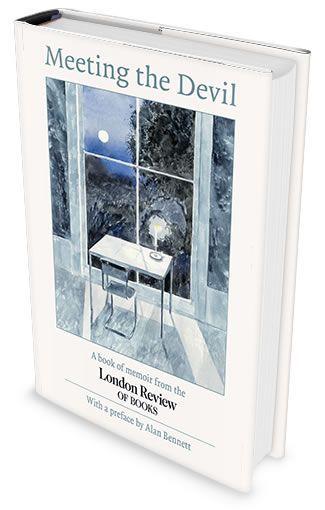
Meeting the Devil: a book of memoir from the London Review of Books (Heinemann, £25)

meeting the devilThe London Review of Books has a more or less permanent place on the front counter at Five Leaves Bookshop. Hopefully we will become intellectuals by osmosis, but more importantly it is a reminder of the best bookshop in Britain – the London Review Bookshop. Oh, if only we were in London, three minutes from the British Museum with a major international magazine behind us. Still, we have LeftLion and we are next to a bookies.

The LRB can be quite hard to read at times. A little too much on German philosophy after Hegel in the current issue, but, like the recent looong article on Julian Assange, David Renton’s article remembering the murder of Blair Peach will stay long in the memory. The LRB is like that, annoyingly over-intellectual and obscure one minute, with searing articles the next. And the authors are given enough space to develop their articles. The mag is serious about what it does. One of the best features is the inclusion of memoir, often lengthy pieces – which have been collected in this book. The title memoir is by Hilary Mantel, on a medical crisis. Others memoirs that will stick with me are by Edward Said on trying to live in the space between his role as an academic and as a campaigner for Palestine and, especially, Joe Kenyon on his days as a miner prior to nationalisation. Other pieces have become familiar – Alan Bennett on “The Lady in the Van” and Lorna Sage’s “The Old Devil and His Wife”. The latter is a demolition job on her awful grandparents which (I am almost certain) appeared as part of her family memoir Bad Blood which could be described as mis lit but transcended the genre. Not all the pieces are so good. A.J.P. Taylor’s “Breakdown” needed a paragraph or two of explanation while, surprisingly, the LRB’s long-standing editor Mary-Kay Wilmers’ article about her attitudes to the women’s movement was one of the weakest in the book.

Some of the pieces reach into the past, such as Tariq Ali writing about his strange visit to North Korea forty-odd years ago but the collection ends with Jenny Diski visiting the future – planning her own funeral.

I could say this is a book to dip into… but I’ve been reading it steadily, article after article. And I want more.

Ross Bradshaw


Survivors: Hungarian Jewish Poets of the Holocaust, edited and translated by Thomas Orszag-Land (Smokestack Press, £8.95)

SurvivorsI J Singer, the lesser known brother of Bashevis Singer, also a Yiddish novelist, wrote in an essay in 1942 of the “tsvey toyznt yoriker toes”, the two thousand year mistake – the thought that Jews could be accepted in Gentile society. Whether Jews sought assimilation or separation, whatever they did, the Gentile world would not accept them. He held this position only briefly, drawing the conclusion that only Jewish nationalism would resolve this situation. This is not a view I share, yet looking at the last hundred years of Jewish life in Hungary, it becomes harder to argue – over that country if nowhere else.

Partially as a direct result of previous oppression, Jews were over-represented in the failed 1919 Hungarian revolutionary government which was followed by two years of anti-Semitic “white terror”.  Jews were just too left wing. The impact of the Holocaust is well known, some 600,000 Jews being killed, with the direct involvement of Hungarian fascists. Many were Christians as the Hungarian laws defined Jews by ancestry rather than religion. This number included the poet Miklos Radnoti, a Catholic, whose poems are included here. Some Christians were just too Jewish. In the wake of the 1956 uprising against the Communists there were further pogroms. And now we have Jobbik, which sees Jews everywhere, including, again, those whose families are long converted to Christianity. It wants them out.

It is with Jobbik in mind that I read this new collection of Holocaust poetry by Hungarian Jews, some of whom were not, unfortunately, as the title suggests, survivors. The poems are more than ably translated and the collection edited by Thomas Orszag-Land, himself a hidden child in Hungary during the Holocaust. The stand out poets are Radnoti and – new to me – Andras Mezei, who did survive the war. But it is a collection that is hard to read, remorseless in tone. In a rare positive moment Mezei concludes a poem “For love redeems the fence of death”, but it really is hard going. Perhaps it has to be.

Ross Bradshaw

The Woman Who Thought Too Much by Joanne Limburg (Atlantic, £8.99)

womanwhoEverybody in Nottingham will know “the lions”, which sit patiently guarding the Council House, providing a meeting point for first dates and a thousand photo opps for small children who like to sit on top of the beasts. The lions were presented to the City by Sir Julian Cahn, whose biography mentioned that he suffered from terrible OCD (obsessive compulsive disorder), a reminder that OCD can strike people of any class, any religion, any ethnic grouping, any gender. This point was made by someone attending a Bookshop discussion with Joanne Limburg.

The Woman Who Thought Too Much is Joanne’s own memoir of living with OCD, which was not diagnosed until she was 29. Unlike some, most of her OCD is in her head – obsessive thoughts rather than compulsive behaviour, though in the book she describes her wounds from compulsive skin picking and the way her obsessive thoughts led to restrictions on her life and made demands on others, especially her husband. It is not only the sufferers of OCD who are affected by it.

Joanne’s memoir is wonderfully written, at times witty. Chris married me and my disorder at the end of August, and then the three of us went off on honeymoon to Venice, the perfect venue for generating both romantic memories and imaginary near-drowning incidents. In her case she has been helped by cognitive behavioural therapy, though not by analysis, and she is enthusiastic about prescribed drugs for her own condition, accepting that these might not be for all. The only part of the book that was hard going was the descriptions of her time trying to get the appropriate drugs, though it was difficult, earlier, to be accepted as having a problem as she presents as “normal” in her behaviour. If a little odd. The oddness was sometimes explained as being a poet, “since we are expected to be odd”. At the shop meeting to discuss the book many people talked openly of their own OCD, feeling that simply sharing own’s own experience is part of dealing with, getting rid of, the shame attached to the condition. Given that up to a million people have genuine OCD symptoms (not just wanting their CDs to be in order, as one wag said), there’s a lot of it about.

Some people cope well with the disorder, others struggle with the “Awesome fecundity to OCD: all the time it throws out new shoots, new runners – new compulsions, new obsessions.” The Woman Who Thought Too Much will be useful to any OCD sufferers, but is also a book for others who might want to better understand their friends with OCD. 

By chance, the national organisation of OCD sufferers is local to us, it’s OCD.UK, which has a very useful website and an interesting national conference coming up.

Ross Bradshaw