Yearly Archives: 2021

Trans-Europe Express by Owen Hatherley (Penguin, £9.99)

Ah, Europe, I remember it well…
Owen Hatherley’s book was written two years after the EU referendum but before the endless negotiations on fish that were to follow. This book is about the architecture of some European cities, some well-known, some less well-known in this now less European nation.
Not all come out well. Paris, for example, won’t be hurrying to give Hatherley the freedom of the city soon but Skopje’s council must have been tempted to hire a hitman other than they blew all their money on “a diarrhoea of statuary…. variously celebrating Ancient Macedonia… sundry medieval kings and folk heroes, a rotunda decorated with Third Reich-esque golden statues … and of course a triumphal arch…” The latter is pictured with the caption “Come and see the sights”. No thanks. “The effect is North Korea without the planning…” Let’s move on. But maybe not to Dublin unless we like “luxury flats” or the “stunning offices” that developers like to foist on us.
But at least Dublin does not have the (literally) Fascist Edificio España of Madrid, “a stepped, stone-clad ziggurat”, which has become a hotel since this book was published. Look it up on Google images. You will regret it. Fortunately Hatherley’s image does not show the building in all its Francoist glory. Indeed, I have to mention the photographs in general. They are poorly reproduced, in the paperback and the earlier hardback. If you are describing buildings like the Modernist Aarhus City Hall, for example, designed by Arne Jacobsen and Erik Møller, whose clocktower “is both chic and jolly” with “its serif Roman numbers incised into the clock-face, which is attached to the concrete frame” there’s something you need to see here and you can barely make out that something in the photograph. By the way, I specifically mention Jacobsen by name here as Hatherley reminds us that Christine Keller sat in a Jacobsen chair – that chair – in 1963.
Hatherley does make me want to go to many places – Rotterdam, to see the public housing estate Kiefhoek which “consists of tiny terraces, painted in the De Stijl colours – crisp yellow metal window frames, red doors and white stuccoed walls.” The Five Leaves’ logo is based on De Stijl designs so we have an interest here. But also because I want to see something he describes as an “hysterical church, a white cube with a chimney that could pass as a boiler house”. And while there, why not nip over to Hilversum to see “what appears to be a police station for Hobbits.”
By now you will have guessed that I love Hatherley’s writing, but his work is serious. He understands cities, though questions  why Stockholm, with Sweden’s enlightened asylum and immigration policy, has housing that appears to be segregated. Yet the Husby estate, which houses the poorest, with high rates of unemployment and which is overwhelmingly non-white (and was the place of a past riot) is “better maintained than Hampstead”. In passing Hatherley often talks about the high level of maintenance by those who run social housing and those who live in them compared to the UK. But again the pictures are not good enough to prove what he was saying.
So… for the moment, let’s pretend Covid is over and you can go where you want. Of all the places described the one that draws me in is….. sound of trumpets…. Hull. Actually, I really like Hull, with its Georgian terraces (well, there are some), its Old Town, the Hepworth Arcade, a street called The Land of Green Ginger, the smell of mud as you walk out to the sea… And you arrive in a wonderful station, one you can sit in. I was in Hull on the launch night of Hull being a city of culture, staying in the most comfortable and affordable hotel (with the most boring breakfast) to join 10,000 others at nightfall to be showered with feathers by high-wire dancers dressed as angels (perhaps you had to be there…). Anyway, read Hatherley’s chapter and go to Hull. You won’t regret it.
Trans-Europe Express is available here: fiveleavesbookshop.co.uk/product/trans-europe-express-tours-of-a-lost-continent/
Ross Bradshaw
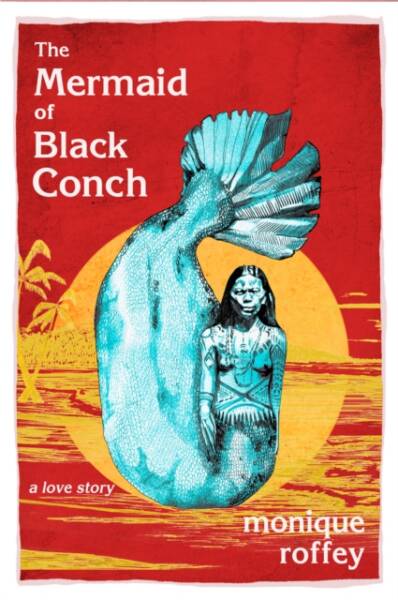
The Mermaid of Black Conch by Monique Roffey (Peepal Tree, £9.99)

Patience is a virtue… After thirty-five years, the tiny team at Peepal Tree has finally hit the big time, with their novel Mermaid of Black Conch winning the Costa Book Award at the same time as their Green Unpleasant Land, on the links between slavery and country houses, is debated, well, attacked, by the paragons of virtue at the Daily Mail and Daily Telegraph. I’m not sure if the DM/DT are angry that someone has noticed these links or whether they are angry that someone did not think such links were a good thing…. This less than two years since Roger Robinson won the TS Eliot Prize for poetry with Portable Paradise, Peepal Tree’s previous best seller.
For Robinson, his portable paradise, stitched into his family memory is “white sands, green hills and fresh fish.” He could easily have been describing the small island of Black Conch. There, in 1976 David Baptiste was out in his boat doing a bit of leisurely fishing, in his favourite quiet area, playing his guitar and smoking the odd spliff. And it is there he finds an audience – the mermaid who comes to listen. To be honest I had doubts about the book in advance, well, mermaids… but I was hooked. As indeed was the mermaid who would get caught by some Yankee sports’ fishermen. Roffey’s description of their struggle – or rather the struggle of the two white men, first the son, then the father – to reel her in was gripping. They had to be tied into the “fighting chair” as they would to bring in, say, a marlin. But this was a mermaid. Their crew of local fishermen were aghast, they wanted none of it, but the father could see the money that the mermaid would bring him.
The mermaid is hung up on the dock but is rescued by Baptiste who takes her home, putting her in his bath. However, this was no ordinary mermaid for she was Aycayia, one of the original residents of the Caribbean who had been condemned to roam the sea for thousands of years by a spell. She speaks no English, remembering only a few words of her original language. Nor does she know anything about clothes, of cooked food or of, well, how to go to the toilet when you no longer live in the sea. The book is earthy. Aycayia gradually turns back into a woman – her scales fall off, her tail rots, her feet and hands become less webby, but she never quite loses her mermaid characteristics including her odour of the sea.
Here the other two main characters of the book appear – Arcadia and her born-deaf son Reggie, who communicates in sign language. Arcadia is the only white person on the island, the last of the Rain family which once owned most of the area. But Arcadia speaks the Caribbean dialect of Black Conch, which suffuses the book. She comes to the door with a poetry book by Derek Walcott in her hand. The father of her child is Black. She has no interest in her estate, selling it off cheaply in parcels, bothering little about collecting rent, but there is still the issue of the rich woman on the island being white. Arcadia and Reggie help Aycayia – Arcadia teaches her English, Reggie sign language. She becomes his friend.
How does all this work out? I can’t do spoilers here but can a mermaid really adapt to life in the small town of St Constance on Black Conch? What do the neighbours think – it’s not like you can keep the whole incident a secret. So read the book. It’s the best novel about fish since Moby Dick.
Despite my reserve because of the subject I was able to suspend belief and cared about all the characters and whether the growing love (OK, a bit of a spoiler) between David and Aycayia could possibly work. There is drama in that Aycayia still feels the call of the sea and those who condemned her to live forever in the sea are watching and angry.
This is Monique Roffey’s seventh book and the one that will have made her name, being already shortlisted for other prizes. She will be reading and being interviewed by Deirdre O’Byrne at a Five Leaves online event on 14 April.

The book is available here:fiveleavesbookshop.co.uk/product/the-mermaid-of-black-conch-a-love-story/

Ross Bradshaw

Dead Land by Sara Paretsky (Hodder, £8.99)

Crime writer Sara Paretsky has caused me many late nights and forced me to lie in many lukewarm and colder baths down the years. She writes short, often wittily-titled, chapters that have a cliff-hanger component that make you think “I’ll just read one more…” again and again. Her latest paperback, her 24th, is no exception.
Paretsky’s female Private Eye is V.I. Warshawski and her milieu is Chicago. Dead Land is up to date with a throwaway comment about the legal problems of a couple of Trump’s advisers and a sub-plot about armed militias and people believing right-wing conspiracies. But some things don’t change: her support group of an elderly doctor and a cranky neighbour and her frustrating relationship with a local journalist. And the basic storyline of big money ruining her city. Somehow you just know that if Warshawski turns up at a small community meeting about Chicago maybe redeveloping a shoreline wildlife park that dark money has changed hands, someone will be bumped off and that Warshawski will be in peril. Formulaic? Maybe, but you get to know the city – you can almost hear the planes coming in to land at O’Hare – and in this book she causes you to search your memory about what the Chicago School of economists were up to in Chile in the 1970s because the past is never just the past. The Chicago Boys – as they were called – have a lot to answer for.
Chicago is of course not Nottingham but is it really true that heads of Council departments (in this case Parks) go round with hired muscle and police protection? Maybe, it is America… It’s certainly scary when she includes the sentence, justifying her unofficial crime fighting that “Chicago police clear only 17% of our homicides each year.”
If I had a criticism it is that like other semi-formulaic books (I’m thinking of Robert Parker) there comes a moment when you feel you have had enough; enough of Warshawski’s neighbour Mr Contreras and her guardian angel Charlotte Herschel (both of whom must be about 105 by now), her running to the Lake with her dogs, the mentions of her opera-loving late mother and her late Chicago policeman father.
But after a few books away, this is what drew me back, comfort reading, and the promise of a bath that starts off hot and ends lukewarm at best.
Ross Bradshaw
Orderable here: fiveleavesbookshop.co.uk/product/dead-land-v-i-warshawski-20/